Before anything flew, the complete plant was designed and programmed as a full digital twin. Every device was modelled from its datasheet and tested, 113 of them live against the PLC. It is being virtually commissioned area by area. That twin is what you see on these pages.
Why this project exists
This project exists to show, in one complete case, how I engineer and build digital twins of industrial plants. The scenario is fiction. The engineering is the work of a real project:
- The plant concept and the layout
- The selection of industrial devices from the makers' catalogues
- The safety planning: zones, muting, safety scanners and switches, the emergency stop chain
- The interconnections: I/O lists, fieldbus topology, signal and parameter lists, the interfaces between machines and areas
- The PLC programs for every area
- The device models with their real behaviour
- The test campaigns that run the whole plant in the twin before any hardware exists
The goal is a plant that a commissioning team could take to site with fine tuning, not a redesign.
Method
The twin is a full working copy of the plant in software. Its 186 devices are real, orderable catalogue products, modelled from their datasheets. The control code runs on a real PLC (programmable logic controller) runtime, with real fieldbus data. Wiring faults can be injected.
Virtual commissioning tests the control code against the twin, from device up to plant. Devices are done. Each area has its own PLC program and its own 3D scene, and each vehicle has its own PLC.
Today all 10 area scenes are built. Two areas are virtually commissioned and closed. Four more are in test against the PLC, and one is in its first test rounds. In the last three the PLC program is written, and the first test window against the PLC is next. The plant is being virtually commissioned area by area.
So far the twin's findings log has 436 log entries. Of these, 419 are plant faults that the twin found before any hardware existed: in drivers, safety wiring, timing, order codes and dimensions.
Driven by the PLCAbout the films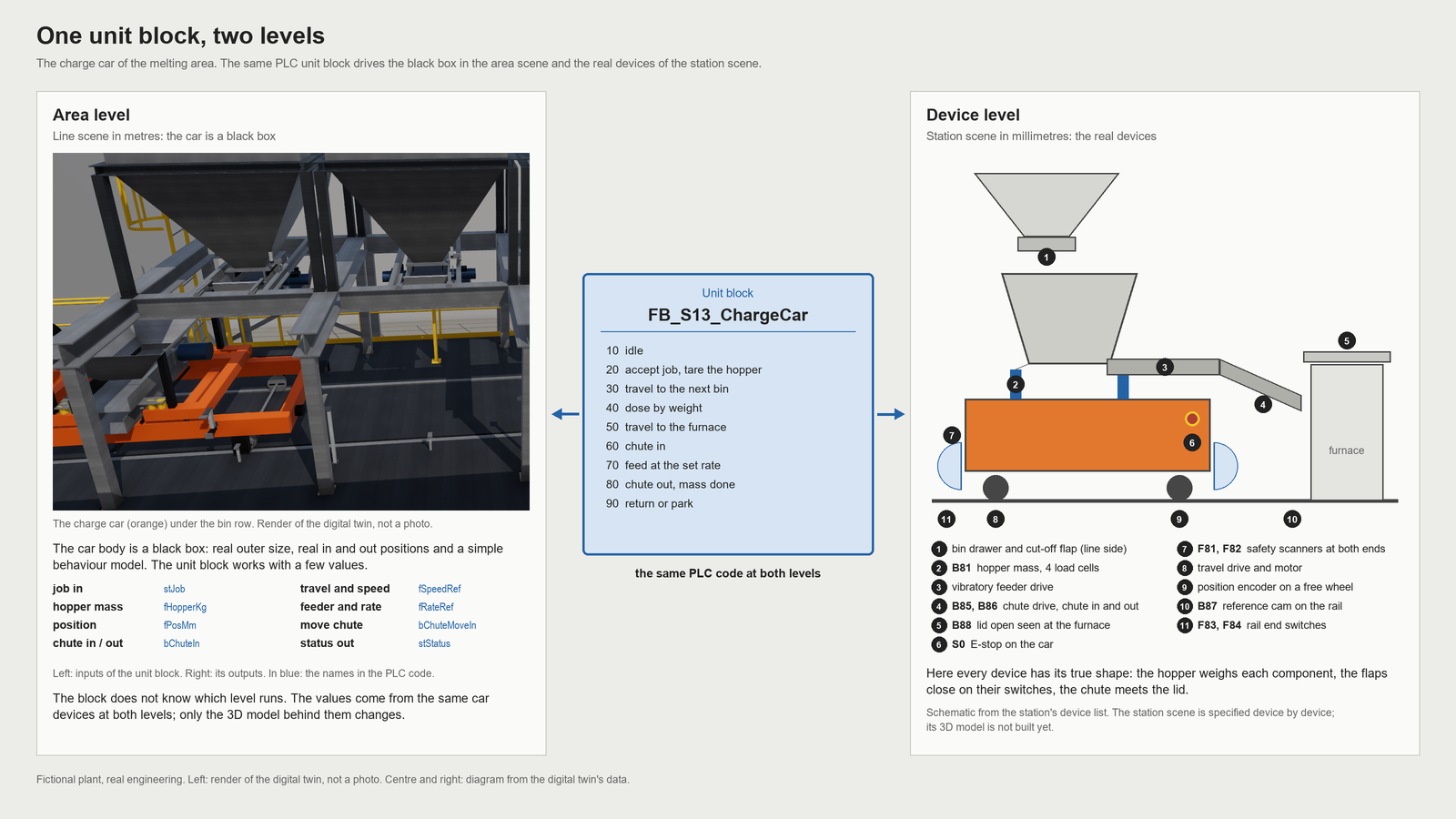
The other chapters
Work status
Where the work stands today
EngineeringRead on
About this page
Real devices, built from real data
Every machine and device in this twin is a real industrial product from the makers' catalogues. They range from sensors, valves and drives to safety scanners, load cells and RFID readers. Each model is built from the product's published data: dimensions, sensing ranges, signals, rated values, parameters and timing.
The PLC programs use the devices' real interfaces and parameters. Before any hardware existed, the twin found hundreds of faults in the plant design and the programs. So a real commissioning would need fine tuning, not a redesign.